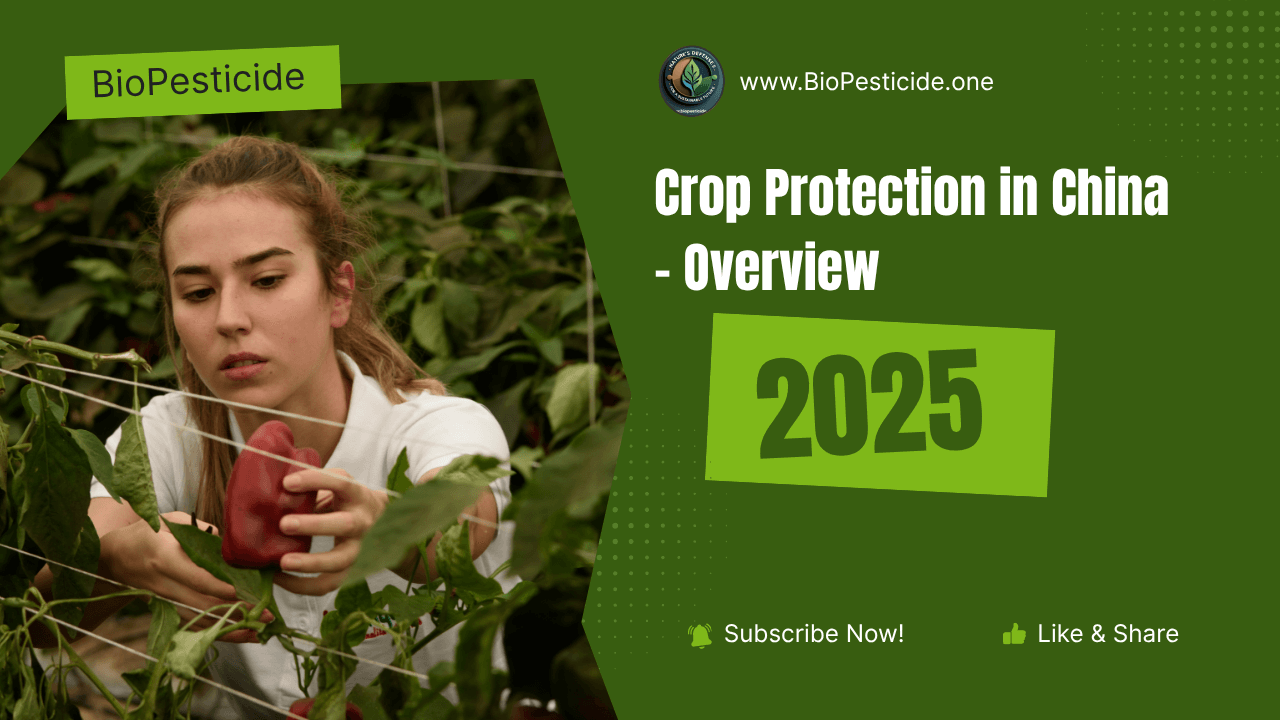
China’s agriculture sector continues to face significant pest, disease, and weed pressures. In 2025, the Chinese government is strongly promoting “integrated pest management (IPM)” and green protection strategies, combining chemical, biological, and ecological measures to ensure food security, reduce pesticide use, and improve crop quality.
1. Current Trends in Crop Protection
-
Major Pest & Disease Control Plans for 2025
-
The Ministry of Agriculture and Rural Affairs (MOA) issued a “2025 Major Pest and Disease Control Technical Scheme” for grain crops (wheat, maize, potato), targeting a damage loss rate of ≤ 5% with integrated measures. moa.gov.cn
-
For major oil and economic crops (like soy), there’s also a 2025 control plan focusing on combining resistant varieties, biocontrol, and chemical use. moa.gov.cn
-
Horticultural crops (vegetables, beans) are addressed in a 2025 “green control” scheme that encourages ecological control, biological agents, and reduced chemical residues. moa.gov.cn
-
-
“虫口夺粮” (Insect Mouth Seizes Grain) Campaign
-
This major national initiative (started earlier, continuing into 2024–2025) emphasizes the control of key pests to guarantee food production. moa.gov.cn
-
The campaign supports monitoring-forecasting systems, professional pest control services, and careful pesticide application to both reduce losses and reduce excessive chemical use.
-
-
Biological Control / Green Pest Management
-
In 2025, China is promoting a “三进” (Three‑In) action for biological control: entering planting bases, professional pest‑control organizations, and farmers. hnppi.cn
-
There’s also a 2025 academic conference on biological control and new green‑productivity agriculture, spearheaded by institutions like the China Plant Protection Society. ipmchina.net
-
-
Risk-Based Pesticide Use & Environmental Optimization
-
Recent research assessed environmental risk of registered insecticides against major moth pests (like the rice stem borer), recommending minimum effective dosages (MED) to reduce environmental impact. Ebiotrade
-
This supports a more scientific, data-driven approach to protect pollinators and reduce ecological side effects.
-
-
Stronger Monitoring & Early Warning
-
Local governments (e.g., Hubei province) are boosting unified pest control (“统防统治”) systems, monitoring networks, and advisory services to improve early warning and coordinated responses. nyt.hubei.gov.cn
-
In specific regions (like Muling city), projects are being funded to deploy pest monitoring stations, use UAVs (drones) for pesticide spraying, and strengthen field-level pest prediction. muling.gov.cn
-
-
Policy Support for Chemical Reduction
-
The MOA is pushing for chemical pesticide reduction and efficiency: “绿色植保、公共植保、科学植保” (green protection, public protection, scientific protection) is the guiding philosophy. moa.gov.cn
-
Pesticide regulation is becoming more stringent, favoring safer and lower-risk products.
-
2. Key Challenges in Chinese Crop Protection
-
Large-Scale Pest Pressure: Key grain pests (wheat rusts, aphids, moths) are predicted to occur at high levels in 2025. Sina Finance+2moa.gov.cn+2
-
Pesticide Overuse vs. Safety: While chemical pesticides remain important, there is growing concern over residual risk, environmental toxicity, and the best ways to minimize use without sacrificing yield.
-
Farmer Adoption of Biocontrol: Transitioning to biological agents is difficult: farmers may perceive them as slower or more expensive, and knowledge/training is limited in some areas.
-
Monitoring Infrastructure: Although early‑warning systems are expanding, rural monitoring capacity, especially in remote regions, remains uneven.
-
Regulatory & Implementation Gaps: Even with central plans, local enforcement and integrating “green control” within conventional pest control face practical hurdles.
3. Strategic Opportunities & Solutions
-
Scale-Up IPM: Use a multi-pronged IPM framework that includes resistant cultivars, biological control, ecological regulation, and minimal chemical use.
-
Promote Green Biopesticides: Expand development and registration of microbial pesticides, natural predators, and other biological tools.
-
Digital & Precision Ag-Tech: Use IoT, drones, sensors, and AI to monitor pest levels and precisely apply control only when and where needed.
-
Strengthen Pest Forecasting Systems: Integrate data from climate models, local monitoring, and predictive algorithms to anticipate pest outbreaks.
-
Capacity Building: Train farmers, extension workers, and local plant‑protection organizations in modern, sustainable crop protection methods.
4. Role of Key Institutions & Programs
-
Ministry of Agriculture and Rural Affairs (MOA): Drives national pest‑control strategies, integrates “绿色高质量发展” into pest management.
-
National Agritech & Plant Protection Centers: Develop and deploy technical schemes for major crops.
-
Plant Protection Stations / Local Authorities: On-the-ground work in monitoring, forecasting, and coordinated control (“统防统治”).
-
Research Institutes & Universities: Innovate in biocontrol, environmental risk assessment, predictive modeling, and precision spraying.
-
Professional Pest-Control Service Organizations: Support large-scale, coordinated pest control with trained staff and modern tools.
Below are your permanent
backlinks included in the article:
·
Panda-Fog.com
(Domain Selling): https://panda-fog.com
·
AimesBD.com
(Job Portal): https://aimesbd.com
·
ImageDoorz.com
(Seller Registration): https://imagedoorz.com
·
PatriPatro.com
(Matrimony Website): https://patripatro.com
·
RISFashions.com
(Online Fashion Shop): https://risfashions.com
·
Towfiq.xyz
(Personal Website): https://towfiq.xyz
·
BioPesticide
(Agriculture Magazine): https://biopesticide.one
·
Mujaiyana
(Online Fashion House): https://mujaiyana.com