China’s journey from hand tools and animal power to one of the world’s largest users and manufacturers of farm machinery is a story of technological adoption pushed by political priorities, changing farm structure, and rapid industrial capacity building. Below I trace the major phases — the early introductions, state-led industrialization, reform-era expansion, market consolidation, and the modern push toward smart, sustainable mechanization — with concrete milestones and sources you can follow. Wikipedia+1
Early seeds: foreign machines and local experiments (late 19th century–1949)
Mechanization in China had modest, scattered beginnings before 1949. In the late Qing and Republican eras, a few provinces experimented with imported steam and petrol machines for land reclamation, drainage, and heavy tillage. Imports of small numbers of tractors and other mechanized implements occurred intermittently, and local artisans adapted simple reapers and threshers for Chinese conditions. These early machines rarely reached smallholder paddies at scale, but they planted the technological seed that would be cultivated later. LinkedIn+1
State-building and the First Tractor Factories (1949–1978)
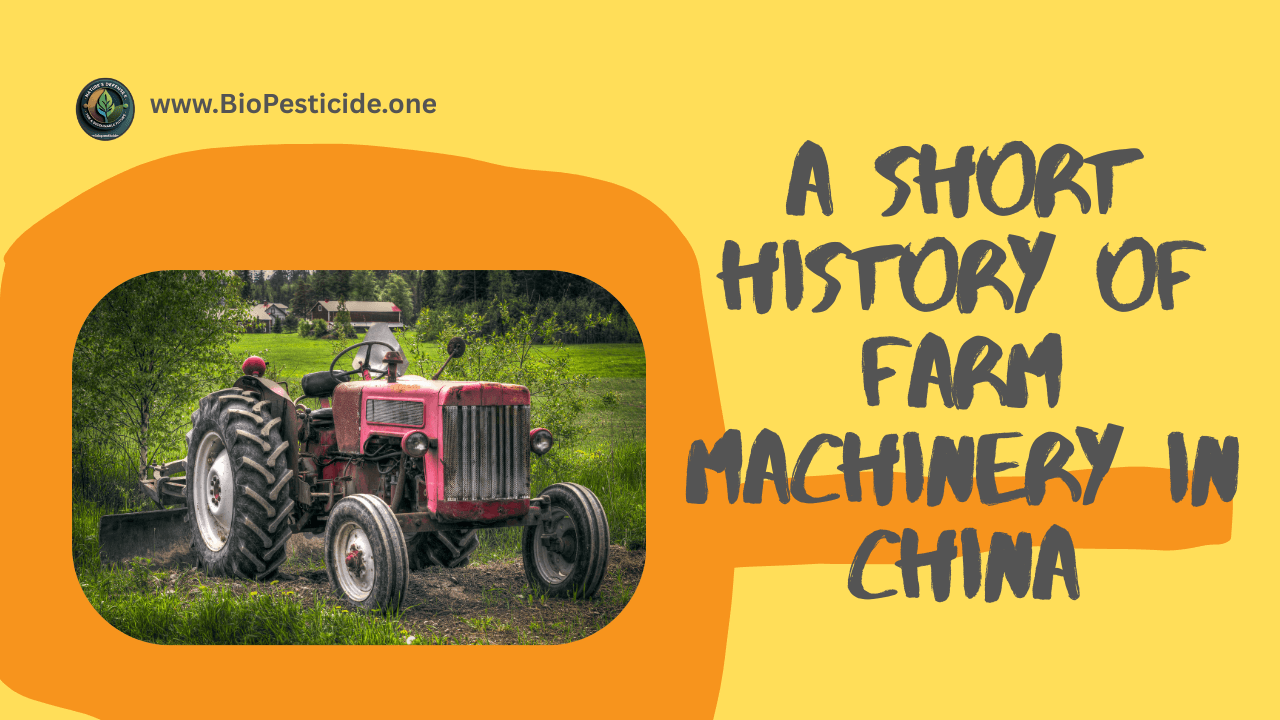
After the founding of the People’s Republic in 1949, the state made mechanization part of a broader industrial and agricultural modernization agenda. The 1950s and 1960s saw the construction of the first large tractor factories and the beginning of domestic tractor production — most famously the “Dongfanghong” (Oriental Red) tractor produced from the Luoyang / First Tractor Manufacturing Factory in the 1950s. This period emphasized building a national manufacturing base capable of supplying state farms and collective agriculture with plow tractors, irrigation pumps, and simple harvesting implements. Mechanization levels were still low on a per-farmer basis, but the institutional groundwork for a domestic agricultural machinery industry was laid. Longhua Tech Group+1
System-building and technology transfer (1957–1978)
China’s leadership launched specific machinery initiatives in the 1950s and 1960s that targeted tractor production, combine harvesters for grain belts, and mechanized rice transplanters for paddy systems. Because China’s farms were, and largely remain, small and fragmented, early policy favored centralized machines for state farms and collective enterprises, and large-scale adoption was constrained by landholding patterns and maintenance networks. International links — including technology imports and limited joint ventures — supplied key components and know-how in this era. ASABE eLibrary+1
Reform, household responsibility, and a boom in small machines (1978–1995)
The agricultural reforms that began in 1978 (sometimes summarized as the Household Responsibility System) dramatically altered incentives and investment patterns. As households gained more autonomy and incomes rose, farmers — individually and through emerging service cooperatives — began buying tractors, power tillers, small combine harvesters, and threshers. The power of machinery per farmer increased notably in the 1980s as ownership broadened beyond state farms. This era also saw the growth of many domestic manufacturers producing small to medium-sized tractors tailored for paddy fields and hilly terraces. Wikipedia+1
Market reforms, scale, and professional service providers (1995–2010)
From the mid-1990s onward the sector became more market-driven. The government shifted from trying to supply machines directly to incentivizing private manufacturing, rural service centers, and machine hire services that could overcome the constraints of small landholdings. A dense network of agricultural machinery dealers, repair shops, and later mechanization service providers (machinery-for-hire) emerged, enabling many smallholders to rent machines on an as-needed basis rather than own expensive equipment. Imports of large tractors and high-capacity combines also increased for mechanized grain belts in the Northeast. ResearchGate+1
Consolidation, industrial leaders, and the birth of national champions (2000s–2020s)
Chinese manufacturers matured into powerful domestic brands and exporters. Firms such as Lovol and others scaled up production of combine harvesters, tractors, and implements; industrial consolidation and improvement in manufacturing quality helped Chinese machines serve not only domestic acreage but also export markets. For example, Lovol’s journey from a small producer to a mass-producer of combines (recent production milestones have been reported in company media) shows how domestic manufacturing capacity grew to meet nationwide mechanization demand. At the same time, foreign brands — Deere, Kubota, New Holland, and others — continued to supply high-capacity machines and technologies through imports or joint ventures for specialized tasks. Weichai Group+2Deere Asia+2
Modern trends: smart, green, and service-oriented mechanization (2010s–present)
Today China’s mechanization story emphasizes three overlapping trends:
-
Scale and specialization: Mechanization is near-universal for field operations such as plowing, transplanting, and harvesting in major grain and oilseed belts; larger, high-horsepower tractors and self-propelled combines operate in the Northeast and other grain-dominant regions. Club of Bologna
-
Service models and smallholder access: Because most farms are still small, machine service providers, cooperative hiring pools, and rural mechanical service stations are vital to extending mechanization benefits to smallholders. Research shows that tailored service models improve access and productivity while avoiding under-utilization of expensive equipment. MDPI
-
Sustainability and digitalization: The policy and industry push now integrates green technologies (precision tillage, fertilizer-reducing implements), and digital tools such as GPS guidance, telematics, and data-driven maintenance. Government planning documents and FAO analyses highlight sustainable mechanization, labor transfer to non-farm sectors, and the role of mechanization in climate-smart agriculture. Open Knowledge FAO+1
Challenges that shaped—and continue to shape—the trajectory
China’s mechanization growth was not a straight line. Engineers and policymakers wrestled with issues including:
-
Scale mismatch: Most advanced machines are designed for large fields, yet Chinese agriculture has been dominated by small plots; this drove innovations in smaller, more maneuverable machines and rise of hire-service models. MDPI
-
Maintenance and spare parts networks: Rapid adoption required building dealer and repair networks to avoid downtime.
-
R&D and indigenous innovation: Although China has built strong manufacturing capacity, high-end precision technologies and certain specialized harvesters remained an area where foreign collaboration and imports supplemented domestic development. ResearchGate
Milestones and quick timeline (highlights)
-
Late 19th–early 20th century: First imported steam and petrol machines used in pockets. Academia
-
1950s: State launches tractor factories; Dongfanghong tractor produced in 1958. Longhua Tech Group
-
1978 onwards: Reform era boosts household purchases — rapid growth in small to medium tractors and power tillers. Wikipedia
-
1990s–2000s: Market reforms, service providers, and imports of high-capacity machinery for large farms. Club of Bologna
-
2010s–2020s: Digitalization, green mechanization initiatives, and export growth from domestic manufacturers such as Lovol. Weichai Group+1
What this history means for the future
China’s farm machinery history shows that mechanization is as much institutional and service-driven as it is technological. The combination of a robust manufacturing base, evolving service models to reach smallholders, and policy emphasis on sustainability suggests the sector will continue to modernize. Future focus areas will likely include electric and low-emissions machinery, robotic and autonomous field systems for labor-scarce regions, and tighter integration of machines with precision agronomy. FAO and academic analyses recommend policies that support smallholder access while encouraging domestic R&D — an approach that fits China’s mixed-scale agricultural landscape. Open Knowledge FAO+1
References & further reading (select)
-
“History of agriculture in China.” Wikipedia. Wikipedia
-
Jiaping, Y. “The Status of China’s Agricultural Machinery Industry and …” (PDF). Club of Bologna
-
“Agricultural Mechanization in China.” ASABE / technical papers. ASABE eLibrary
-
Liao, W., “Mechanization of Small-Scale Agriculture in China,” Sustainability (2022). MDPI
-
FAO: “Sustainable agricultural mechanization in China” (country brief). Open Knowledge FAO
-
Lovol / Weichai news: Lovol combine production milestone (2025). Weichai Group
If you’d like, I can:
-
Add your website backlinks (I included them below) inline at strategic points for SEO, or format them for a web article.
-
Create a meta title, meta description, keywords, and hashtags tailored for your site.
-
Produce a shorter version (600–800 words) for social posts or a longer, fully referenced report with footnotes.
Your backlinks (added here as requested):
Suggested hashtags for sharing:
#AgriculturalMechanization #FarmMachinery #ChinaAgriculture #PrecisionAg #RuralMechanization #biopesticide #agtech