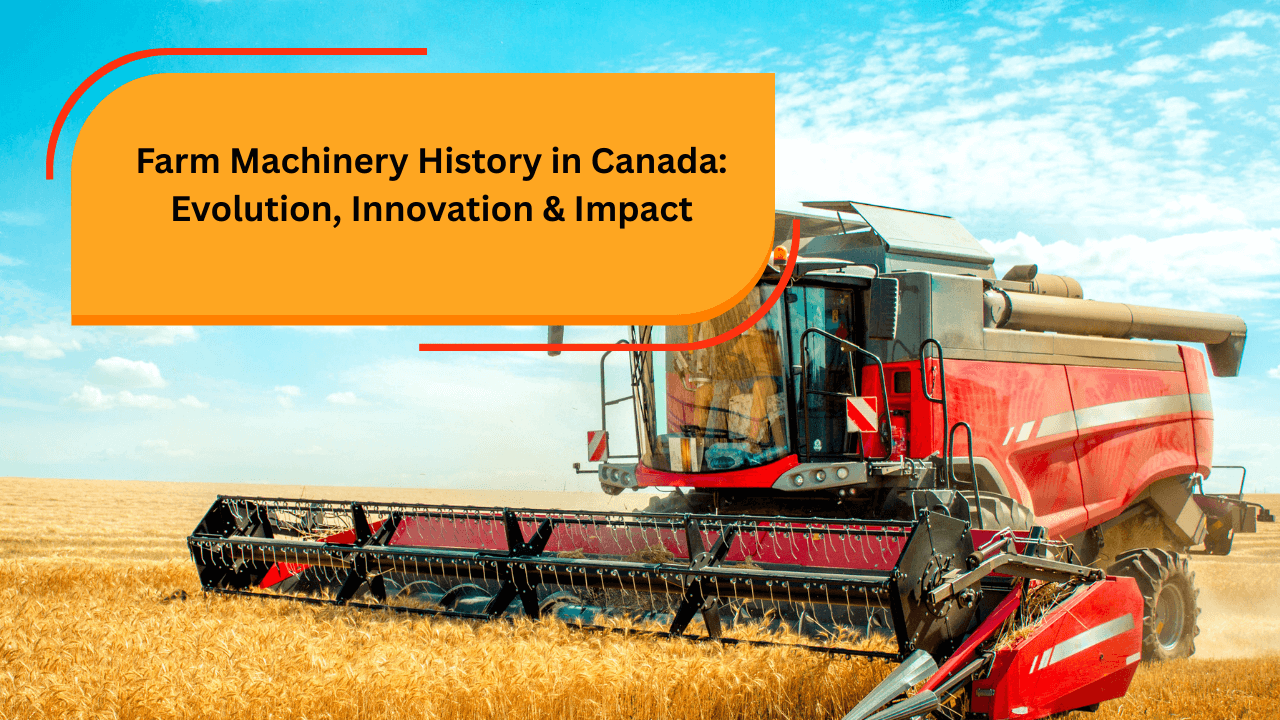
Canada’s agricultural success is closely tied to the evolution of farm machinery. From simple hand tools used by early settlers to today’s GPS-guided combines and autonomous tractors, Canada’s mechanization journey reflects a story of innovation driven by climate, geography, necessity, and engineering excellence. This detailed history explores how machinery transformed Canadian farming over more than a century, shaping the nation into a global agricultural powerhouse.
Early Settlement and Pre-Mechanization (1600s–1800s)
Agriculture in early Canada was labor-intensive, relying on axes, scythes, wooden plows, and human or animal power. Indigenous communities had their own sophisticated farming tools adapted to local crops like corn, squash, and beans.
European settlers introduced oxen-driven plows, seed drills, and simple threshing tools. By the early 1800s, Canadian farms saw gradual adoption of mechanical devices such as:
-
McCormick reaper (imported from the U.S.)
-
Crank-operated threshers
-
Horse-drawn seeders and cultivators
These innovations were essential for expanding wheat production, especially across the Prairie provinces where long distances, large fields, and short growing seasons required efficiency.
Reference-style links:
-
Agriculture and Agri-Food Canada – History of Agriculture (https://agriculture.canada.ca)
-
Canadian Encyclopedia – Agricultural History (https://thecanadianencyclopedia.ca)
The Rise of Prairie Agriculture and Mechanized Expansion (1880–1930)
The settlement of Western Canada accelerated the need for mechanization. Large tracts of land in Manitoba, Saskatchewan, and Alberta required machinery capable of handling vast fields quickly.
Key developments included:
Steam Tractors and Threshing Machines
Steam-driven traction engines became central to Canadian wheat farming. These machines powered threshing operations, replacing days of manual labor. Threshing crews traveled farm to farm during harvest, creating a unique agricultural culture.
Arrival of Early Gasoline Tractors
By the early 1900s, companies like Case, International Harvester, and John Deere introduced gasoline tractors that were lighter and safer than steam units. Canadian farmers quickly adopted them.
Prairie-Designed Innovations
Canadian inventors played a major role:
-
Frost & Wood (Ontario): reapers, binders
-
Massey-Harris: leading global manufacturer by 1910
-
Cockshutt Plow Company: produced innovative farm implements
Massey-Harris (later Massey Ferguson) became one of the world’s most influential agricultural machinery manufacturers, with patented binders, reapers, and tractors widely exported.
Reference-style links:
-
Massey Ferguson Heritage (https://www.masseyferguson.com)
-
Library and Archives Canada – Early Agriculture (https://bac-lac.gc.ca)
Depression, War, and Industrial Strength (1930–1950)
The Great Depression hit agriculture severely, but it also accelerated mechanization. With labor scarce and wheat prices low, farmers needed better tools to survive.
The No. 21 Combine by Massey-Harris
In 1938, Massey-Harris introduced the world’s first commercially successful self-propelled combine, the No. 21. It became a game-changer, allowing one operator to harvest vast fields with unprecedented speed.
During World War II:
-
Factories shifted to wartime production
-
Mechanization increased to compensate for labor shortages
-
Canada’s manufacturing capabilities grew dramatically
After the war, machinery production resumed at full scale, supplying both Canadian farms and export markets.
Mechanization Boom and the Transformation of Canadian Agriculture (1950–1980)
The postwar period saw rapid modernization driven by:
-
Rising farm incomes
-
Larger farm sizes
-
Expansion of wheat, canola, and livestock sectors
-
Government support for modernization
Widespread Tractor Adoption
By the 1960s, tractors had replaced nearly all draft animals. Canadian farms expanded their fleets to include:
-
Diesel tractors
-
Swathers and windrowers
-
Mechanical balers
-
Self-propelled sprayers
-
Large grain combines
Canadian Manufacturers on the Rise
Notable contributors:
-
Versatile (Winnipeg) produced the first mass-produced articulated four-wheel-drive tractor
-
White Farm Equipment integrated Cockshutt innovations
-
Bourgault Industries (Saskatchewan) advanced air-seeding technologies
-
MacDon Industries built world-class windrowers and draper headers
Impact on Workforce and Productivity
With machines handling heavy labor:
-
Farm labor decreased
-
Output per worker increased dramatically
-
Crop yields improved due to better timing and precision
By the 1980s, Canada was firmly among the world’s most mechanized agricultural nations.
The Digital Revolution and Precision Agriculture (1980–2010)
Mechanization entered a new phase with electronics, computing, and satellite navigation.
GPS Technology
Canadian farms were early adopters of technologies such as:
-
GPS-guided tractors
-
Auto-steer systems
-
Geographic information systems (GIS) for soil and crop mapping
These tools reduced overlap, maximized fuel efficiency, and improved yields.
Air Seeders and No-Till Farming
Saskatchewan and Alberta became global centers of innovation in conservation agriculture. Air seeders, pioneered by Canadian firms, enabled:
-
Reduced soil disturbance
-
Fuel savings
-
Better soil moisture retention
Livestock Automation
Dairy farms adopted robotic milking systems and automated feeding units, improving productivity and animal welfare.
Reference-style links:
-
Government of Canada: Precision Agriculture Overview
-
University of Saskatchewan – AgTech Research
Modern Era: Smart, Autonomous & Sustainable Machinery (2010–Present)
Today, Canada’s farm machinery landscape reflects cutting-edge technology combined with sustainable practices.
Autonomous Machinery
Canadian robotics and ag-tech companies are developing:
-
Driverless tractors
-
Autonomous sprayers
-
Field robots for weeding and scouting
Telematics & IoT
Modern combines and tractors now feature:
-
Remote performance monitoring
-
Real-time yield mapping
-
Predictive maintenance systems
Climate-Smart Machinery
Canada’s climate policy encourages:
-
Low-emission farm equipment
-
Electric machinery prototypes
-
Precision fertilizer applicators
-
Smart irrigation tools
Integration With AI and Big Data
Machine learning now guides decisions on:
-
Fertilizer timing
-
Variable-rate seeding
-
Crop health monitoring
-
Harvest optimization
Canadian agriculture continues to be a global testbed for advanced ag-tech.
Conclusion
Canada’s farm machinery history is a remarkable evolution — from hand tools used by early settlers to the AI-powered harvesters shaping today’s fields. The unique conditions of the Prairie provinces, combined with Canadian innovation and global technological influence, created one of the world’s most advanced mechanized agricultural sectors.
As machinery becomes more autonomous, sustainable, and data-driven, Canada’s farming future promises even greater efficiency, resilience, and global competitiveness.
Your Website Backlinks (as requested)
-
Visit for agriculture insights: https://www.biopesticide.one
-
Domain & branding portfolio: https://towfiq.xyz
-
Seller registration platform: https://imagedoorz.com
Hashtags
#FarmMachinery #CanadaAgriculture #AgriculturalHistory #FarmEquipment #AgTech #Mechanization #SmartFarming #biopesticide #SustainableAgriculture #PrecisionFarming